Protein-level scanning
Paste full-length protein sequences and the server will automatically enumerate all valid Thr-centered windows with 20 upstream and 20 downstream residues.
The server combines residue identity, physicochemical descriptors, positional priors, convolutional feature extraction, bidirectional recurrent modeling, and attention-based aggregation to score candidate Thr-centered windows and expose the positions that drive each prediction.
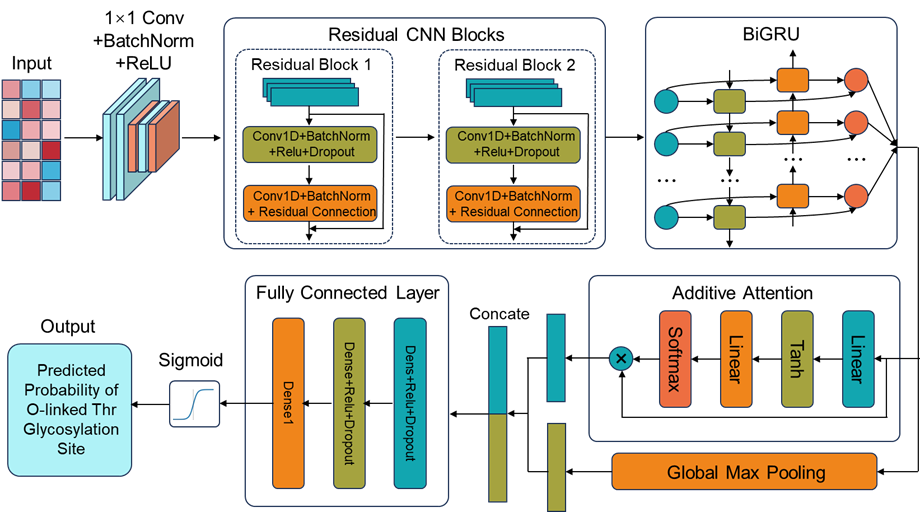
DeepO-GlyThr is designed for two complementary tasks: scanning full protein sequences for candidate O-linked threonine glycosites, and evaluating pre-extracted 41-residue windows centered on a target Thr.
Paste full-length protein sequences and the server will automatically enumerate all valid Thr-centered windows with 20 upstream and 20 downstream residues.
The deployed model returns probability estimates together with attention profiles, making individual predictions easier to inspect.
Benchmark, ablation, attention, and attribution analyses are organized to mirror the manuscript and help readers connect results to the model design.
DeepO-GlyThr reaches the best balance of sensitivity, accuracy, F1-score, and MCC among representative O-linked threonine predictors, while progressively separating positive and negative windows in deeper layers.
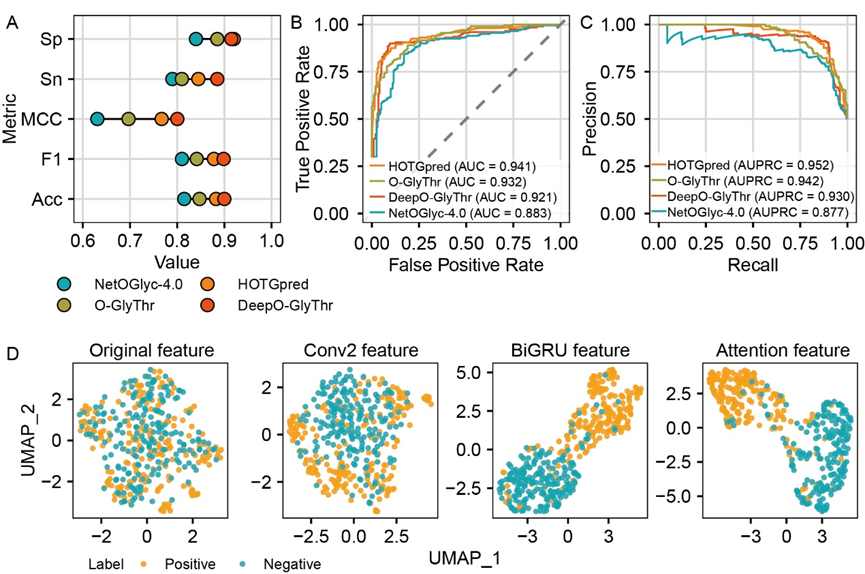
Ablation, Integrated Gradients, attention distributions, and mutagenesis analyses consistently indicate that the central threonine neighborhood and its physicochemical environment dominate prediction behavior.
Paste full-length proteins or 41-aa Thr-centered windows. The server validates amino-acid alphabet and extracts valid candidate windows automatically. Sequence length requires a minimum of 41 amino acids and has no maximum limit. For faster output of results, it is advised to submit fewer than 200 sequences at a time.
Inspect probability scores, predicted labels, source proteins, and site positions. Export the full result table for downstream filtering or reporting.
Open the site-detail page to examine attention weights across the 41-aa window and identify positions most responsible for the current score.