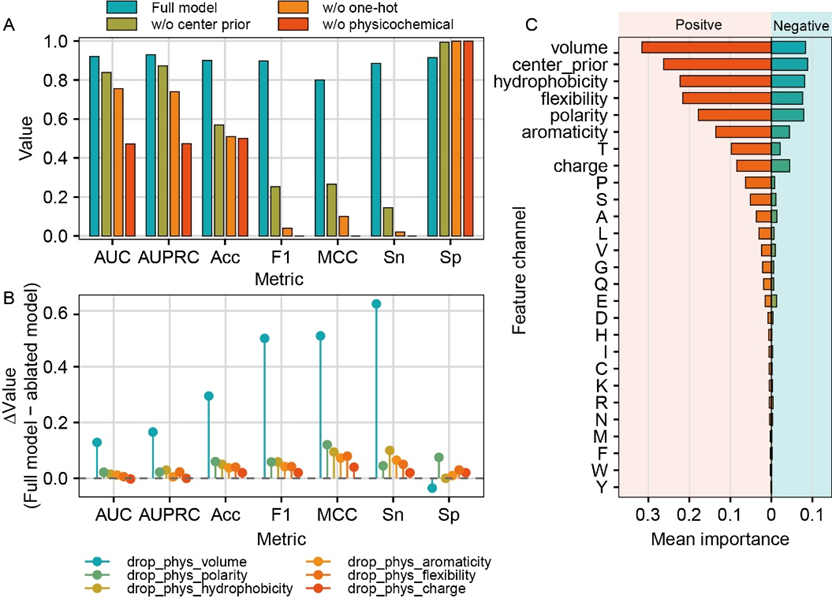
Performance degradation after removing feature groups
The main result is that removing physicochemical channels causes the most severe collapse of positive-site recognition.
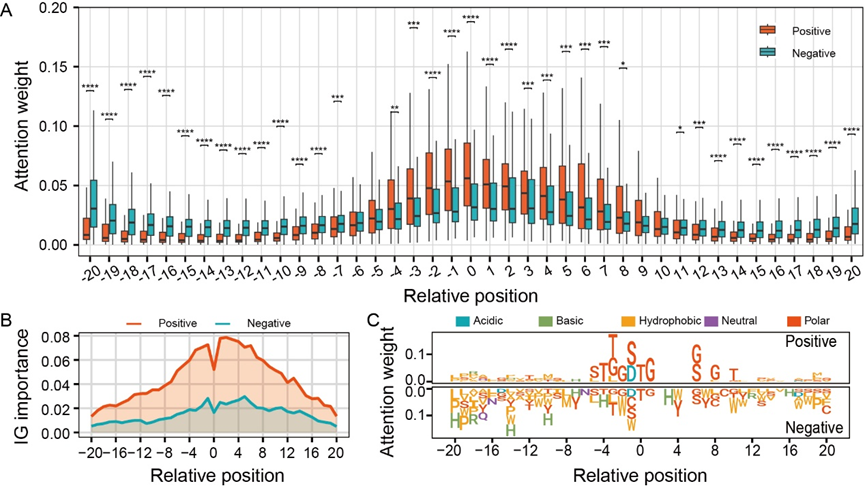
Attention is available per submitted window. This page complements it with global evidence from feature ablation and manuscript-level Integrated Gradients analysis.
The main result is that removing physicochemical channels causes the most severe collapse of positive-site recognition.
The model appears to rely primarily on local sequence context in the central regions, whereas negative samples exhibit more dispersed and distal dependency patterns. Residue-level analysis further suggests distinct position-residue preferences between positive and negative samples.
To evaluate the contribution of different input features, we conducted feature ablation experiments on the independent test set. Compare the full model against variants without center prior, one-hot encoding, or physicochemical channels.
| Model | AUC | AUPRC | Acc | F1 | MCC | Sn | Sp |
|---|---|---|---|---|---|---|---|
| Full model | 0.921 | 0.93 | 0.9 | 0.898 | 0.8 | 0.885 | 0.915 |
| w/o center prior | 0.839 | 0.873 | 0.57 | 0.252 | 0.266 | 0.145 | 0.995 |
| w/o one-hot | 0.755 | 0.74 | 0.51 | 0.039 | 0.101 | 0.02 | 1.0 |
| w/o physicochemical | 0.472 | 0.474 | 0.5 | 0.0 | 0.0 | 0.0 | 1.0 |
The model appears to rely primarily on local sequence context in the central regions, whereas negative samples exhibit more dispersed and distal dependency patterns.