This page condenses the manuscript into a web-first format, covering benchmark construction,
feature engineering, model architecture, and evaluation strategy.
dataset
Benchmark dataset
DeepO-GlyThr follows the benchmark used in the original O-GlyThr study. Positive and negative samples are 41-residue windows centered on threonine, with 20 residues on each side. The final benchmark contains 1,078 positive and 1,078 negative samples, split into training and independent test sets.
encoding
Feature encoding
Each residue is represented by 27 channels: 20-dimensional amino-acid one-hot encoding, six z-score normalized physicochemical descriptors, and one center-prior channel that emphasizes the candidate Thr neighborhood.
architecture
Model architecture
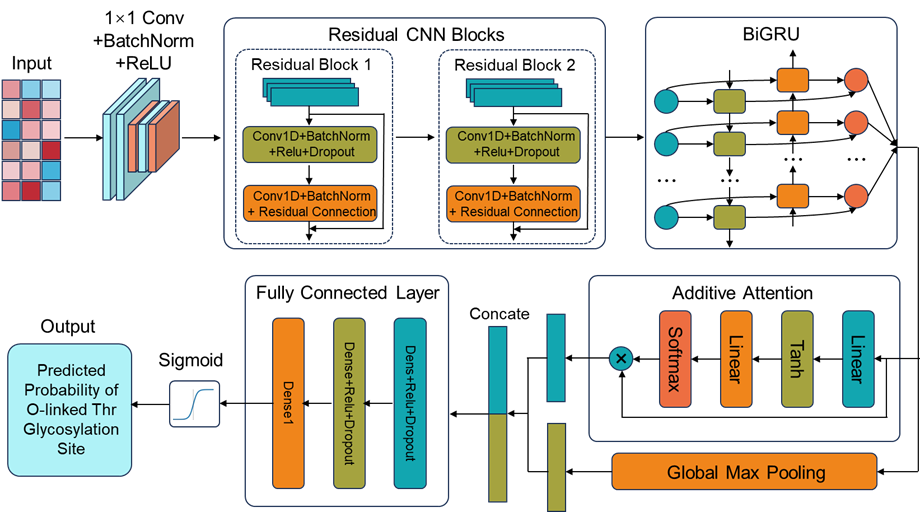
The architecture combines a CNN stem, two residual convolution blocks, a two-layer BiGRU, additive attention, and fully connected classification layers. This design captures local motifs, contextual dependencies, and position-specific importance.
evaluation
Evaluation strategy
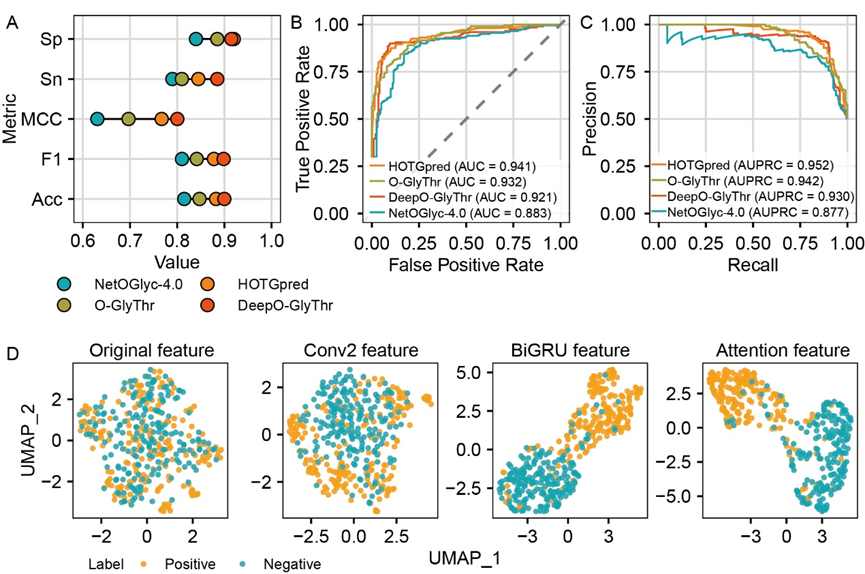
Performance is reported with sensitivity, specificity, accuracy, F1-score, MCC, ROC-AUC, and PR-AUC. The model is intended to rank candidate Thr-centered windows while keeping interpretation accessible for downstream biological inspection.
Recommended citation
DeepO-GlyThr: an interpretable sequence-based deep learning framework for human O-linked threonine glycosites prediction.
Availability
Source code and data are availability in the github.